How to Write SEO Friendly Blog Posts That Actually Bring in Business
The easiest way to write SEO friendly blog posts is to stop writing for Google and start answering the exact question your customer typed into the search bar. Solve their problem in plain language, cut the fluff, and handle the technical basics like headings, meta tags, and structured data. Do that consistently and you rank. But ranking is not the goal. The goal is booked jobs, filled appointments, and real revenue. A blog post that gets traffic but never turns a reader into a customer is just a hobby.
What Makes a Blog Post SEO Friendly?
An SEO friendly blog post is content written to rank in search engines because it clearly and quickly answers what the searcher is looking for. That is the short version.
The real version is simpler than most guides make it sound. SEO friendly content is not about cramming keywords into paragraphs or hitting some magic word count. It is about matching search intent. When someone searches "how often should I get a balayage touch-up," they want a straight answer, not three paragraphs about the history of hair color. Give them the answer fast, back it up with useful detail, and you have already done most of what "SEO friendly" actually means.
The keyword still matters. The structure still matters. The technical setup still matters. But all of it serves one job: helping the right reader get the answer they came for. That is the whole point of good SEO content writing: putting the reader first while still giving search engines what they need.
Start With Search Intent (Pretend You Are the Reader)
Before you write a single line, put yourself in your customer's chair.
Pretend you are the person doing the search. You have a problem. You want a straightforward answer that resolves it. You do not want to scroll past a wall of filler to find it. If you can picture that person clearly and write the post that solves their problem, you are already ahead of most businesses blogging in your space.
This is the part most people skip. They write what they want to say instead of what the reader wants to know. So empathize first. Ask yourself what the searcher is really trying to figure out, then answer that question directly. Forget about "doing SEO" for a second and just make sure you are replying to a real human with a real question. The SEO follows naturally when the answer is genuinely useful. This is exactly what Google's own guidance on helpful, people-first content tells you to do.
Do Your Keyword Research First
You cannot answer search intent if you do not know what people are actually searching for. Keyword research tells you the real words your customers use, how many people search them, and how hard those terms are to rank for. If you want the full picture of how this connects to ranking, our guide on how to rank for keywords breaks down the whole process.
You do not need expensive tools to start. Free options like Google Keyword Planner and the "People Also Ask" box in Google search results will show you what your audience is asking. Paid tools like Semrush or Ahrefs go deeper, but the principle is the same: find out what your customers type, then build content around it. If you are new to this, Ahrefs has a solid beginner's guide to keyword research, and if you would rather hand it off, our keyword research service does the digging for you.
Find the questions your customers are actually typing

The best blog topics are usually questions. An HVAC contractor in West Palm Beach does not need a clever post title. They need to answer "why is my AC freezing up" because that is exactly what a homeowner types at 2 p.m. in July when their system stops cooling. Each real question your customers ask is a blog post waiting to be written.
Pick one primary keyword per post
One post, one main keyword, one clear job. Trying to rank for five different topics in one article splits your focus and confuses search engines about what the page is even about. Pick the primary keyword, write the best possible answer for it, and let supporting terms appear naturally.
Write for One Specific Audience
Here is something I always come back to: when you write for a very specific audience, search engines reward you for it.
When your content clearly speaks to one type of reader, Google understands who it is for and shows it to exactly those people. Write a generic post for "everyone" and it competes with the whole internet. Write a focused post for "med-spa clients in Boca Raton researching lip filler" and you are speaking directly to the people most likely to book.
This is also where local service businesses have a real edge. There is a big difference between ranking for "ac repair" against every HVAC company in the country and ranking for "ac repair Boca Raton" against the handful of contractors in your service area. National traffic looks impressive in a report. Local traffic actually calls and books. For most small and mid-sized businesses, a smaller pool of local searchers who are ready to hire beats a flood of visitors who will never become customers. This is the core of good local SEO, and you can see it in action in our content marketing strategy examples for local businesses in West Palm Beach and Boca Raton.
So get specific. Name the service, name the area, and write like you are talking to one real customer instead of a crowd.
Structure the Post So Readers (and Google) Can Follow It

Good structure helps two audiences at once: the reader skimming on their phone and the search engine trying to understand your page.
Use one H1 for the title. Break the body into clear H2 sections, and use H3s underneath when a section needs smaller parts. Put the answer near the top of each section instead of burying it at the bottom. This "answer first" approach is what earns featured snippets, those highlighted answer boxes at the top of Google results, and it is also what keeps a busy reader from clicking away.
Keep paragraphs short. Use bullet points when you are listing steps or options. Make the page easy to scan, because most people scan before they decide to read. For more on writing that works for both readers and search engines, Semrush has a useful rundown of SEO writing best practices.
Don't Skip the Technical SEO
Writing the copy is only half the job. The technical side carries the other half, and it is the part most business owners forget. If it feels like too much to manage on your own, this is the kind of thing a managed SEO service can handle all the heavy lifting on your SEO for you.
A great article with no technical setup is like a beautiful storefront with no sign on the street. People (and search engines) cannot tell what it is.
Meta title and meta description

The meta title is the clickable headline that shows up in search results. The meta description is the short summary underneath it. Together they decide whether someone clicks your result or your competitor's. Put your main keyword near the front of the title, keep it concise, and write the description like a short invitation that tells the reader what they will get.
Schema markup and FAQ structured data
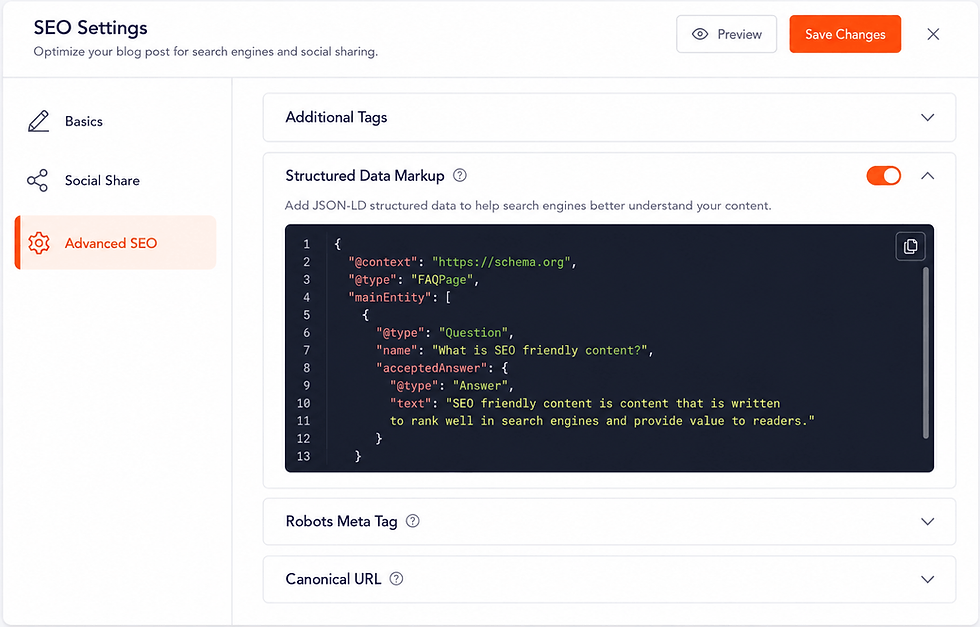
Schema markup is a small piece of code that tells search engines what your content actually is. It is especially worth adding to your FAQ sections. You can see the technical requirements in Google's FAQ structured data documentation.
One honest note here: Google retired the expandable FAQ dropdowns in search results in May 2026, so FAQ schema no longer gets you that extra space on the results page. It still has value, though, because it helps search engines and AI tools cleanly read and understand your questions and answers.
Here is why this matters more than ever. The AI tools people now use to search, ChatGPT, Gemini, and Perplexity, rely on this kind of structured data to quickly understand what your post is about. Clean structure and schema make it easier for these systems to read your content and surface it as an answer. As more of your customers start their search inside an AI tool instead of a search bar, this stops being optional.
Use Images and Infographics That Add Value
Images break up text and make a post easier to get through. But there is a rule: every image has to earn its place.
If an image or infographic does not help the reader understand something, it is just filler, and filler slows the page down without adding anything. A diagram showing what to expect after a treatment, a before-and-after, a simple comparison chart, those add real value. A random stock photo of a smiling stranger does not.
And every image needs alt text, a short written description of what the image shows. Alt text helps search engines understand your visuals, and it makes your content accessible to people using screen readers. It is a small step that most businesses skip.
Link Smart, Internally and Externally
Links do quiet but important work in an SEO friendly blog post.
Internal links point readers to other pages on your own site. Use them to guide people toward the action you want them to take, your service page, your booking form, your product page. If a blog post answers a question and then links the reader straight to the page where they can book or buy, you are turning a reader into a lead. Internal links also help search engines understand how your site fits together, which builds your authority on a topic over time.
External links point to trusted outside sources. Linking to a credible resource when it supports your point builds trust with both readers and search engines. Do not overdo it, and only link to sources you would actually stand behind.
A Real Example: How Blog Posts Generated Real Revenue
Let me show you what this looks like when it works.
In 2025, we worked with BBB Seed, a company that sells grass seed products. We created a set of blog posts written specifically for their target audience, focused on educating buyers about the products. Over five months, those posts brought in more than 30,000 visitors and generated over $10,000 in additional revenue.
What made it work was not traffic for its own sake. The posts were built to help people make a decision. They explained what the products were, compared different options, and laid out the pros and cons so a buyer could feel confident. Then they guided the reader from the blog post to the product page to complete the purchase. The content did the selling by being genuinely helpful first.
Now, BBB Seed is an e-commerce business, and you might run a salon, an HVAC company, or a med-spa. The product is different, but the principle is identical. Educate the customer, help them understand their options, build trust, and guide them to the next step, whether that next step is "add to cart" or "book an appointment." A homeowner deciding which contractor to call and a shopper deciding which grass seed to buy are going through the same decision-making process. Good blog content meets them in that moment.
SEO Blogging Is About Business, Not Just Traffic

This is the part I want you to remember more than anything else.
SEO blog posting is not about creating content and driving traffic to your website. It is about generating business for your business.
Traffic is a number on a dashboard. Leads, booked appointments, and sales are what keep the lights on. A post that ranks number one and brings 5,000 visitors a month but never produces a single phone call has failed at its real job. A post that brings 200 of the right local visitors and books 15 of them has done exactly what it was supposed to do. We dig into this more in our content marketing tips for local businesses that want better leads, not just more posts.
So when you plan a blog post, start from the business outcome and work backward. What action do you want the reader to take? Build the whole post to lead them there.
Frequently Asked Questions
What makes a blog post SEO friendly?
A blog post is SEO friendly when it clearly answers what the searcher is looking for, uses the right keyword naturally, is structured with clear headings, and has the technical basics in place like a strong meta title, meta description, and schema markup. The biggest factor is matching search intent, giving the reader the answer they actually came for.
How long should an SEO blog post be?
Long enough to fully answer the question, and no longer. There is no magic word count. Many pages that rank on the first page of Google land somewhere around 1,500 words, but padding a post with filler to hit a number does more harm than good. Answer the question completely, then stop.
How often should I post blogs for SEO?
Consistency matters more than volume. One well-researched, genuinely useful post per week or even per month beats publishing ten thin posts and then going quiet. Pick a pace you can actually maintain, because SEO rewards steady, ongoing effort, not one-time bursts. Mapping out a consistent blog content plan ahead of time makes it far easier to stay on schedule.
Do blog posts really help local businesses get customers?
Yes, when they are written for the right local audience and built to convert. A blog post that answers a real question your customers have, ranks for a local search term, and guides the reader toward booking can bring in qualified leads for months or years after you publish it. The key is writing for a specific local audience instead of chasing broad traffic that never books.
The Bottom Line
Writing SEO friendly blog posts is not complicated, but it does take a clear approach. Solve the reader's search intent, write for one specific audience, handle the technical setup, and always tie the content back to a real business outcome.
Doing this well and doing it consistently is the hard part. It takes research, writing, technical setup, and follow-through, week after week, on top of actually running your business. That is usually where good intentions stall, and where it can help to have a team write your blog content for you.
If you want a local team to handle this for you so your website starts bringing in leads instead of just sitting there, let's talk. Book a free discovery call with Fede and we will look at what is blocking your growth.


Comments