Keyword Analysis in SEO: Pick Keywords That Bring Customers
Keyword analysis in SEO is the process of reviewing the searches people type into Google and deciding which ones are actually worth targeting for your business. It is not about finding the terms with the biggest numbers. It is about finding the searches that come from people ready to hire you, buy from you, or book with you, then matching each of those searches to the right page on your website. Get that part right and traffic turns into leads. Get it wrong and you can rank for things that never make you a dollar.
What Is Keyword Analysis in SEO?
Keyword research is finding the words people search. Keyword analysis is deciding which of those words deserve a page on your site.
Most guides blur the two together. The difference matters, because the list of keywords is the easy part. Any tool will hand you thousands of ideas in about ten seconds. The hard part is looking at that list and knowing which twenty terms are going to bring in customers, which fifty are worth a blog post someday, and which four hundred you should ignore completely.
That decision comes down to three things: what the searcher actually wants, how hard the keyword is to rank for compared to how strong your site is, and how many people search it. In that order.
Why Most Business Owners Pick the Wrong Keywords
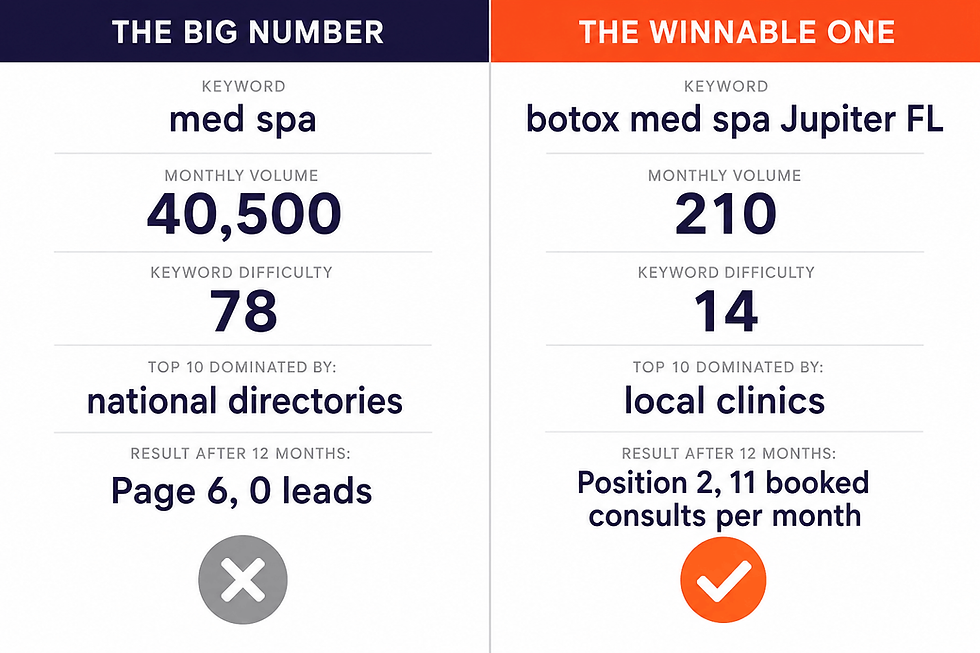
The mistake I see most often is a business owner picking keywords based on search volume alone. They open a tool, sort by the biggest number, and start writing.
Six months later they have traffic and no phone calls. It almost always comes down to three things: chasing volume, ignoring intent, and going after keywords the site is not yet strong enough to win. I covered that volume trap and what it costs small businesses in the importance of keywords in SEO.
None of those are knowledge problems. They are sequence problems. Here is the sequence I use.
The Three Filters I Use to Choose Keywords

Every keyword goes through the same three checks, always in this order. Intent first, difficulty second, volume last.
Volume goes last on purpose. It is the number everyone looks at first and it tells you the least about whether a keyword will make you money.
Filter One, Keyword Intent
Intent means the reason behind the search. What is this person actually trying to do?
Every keyword falls into one of four categories, and the category tells you almost everything about how valuable it is to your business.
Intent type | What the searcher wants | Example searches | Where it belongs | Priority |
|---|---|---|---|---|
Transactional | Ready to act right now. Hire, book, or buy today | emergency ac repair lake worth, roofer near me, book oceanfront hotel palm beach | Service or landing page | First |
Commercial | Comparing options before they commit. Close to buying, not there yet | best roofing companies west palm beach, trane vs carrier ac units, top rated seafood restaurants palm beach | Service page, or a comparison page that routes to one | First |
Navigational | Looking for a specific business by name | all temp solutions phone number, [your business] hours | Homepage, contact page, Google Business Profile | Earned over time |
Informational | Learning. No intent to buy yet | how much does a new roof cost, why is my ac freezing up, things to do in west palm beach | Blog post | Second |
Transactional and commercial keywords are where the money is. Someone searching "roofer near me" is not learning about roofs, they are picking one. Informational keywords carry the bigger volume numbers and convert far more slowly. That does not make them useless, it makes them a longer play.
There is one more layer worth checking, and it trips up a lot of people. The same words can carry two completely different intents depending on who is typing them. Take "software company." That gets searched by people who want to start one and by people who want to hire one. Same phrase, opposite customers. Before you commit to a keyword, ask yourself which of those two groups you want, then look at what is already ranking to see which group Google thinks it is serving.
Filter Two, Keyword Difficulty Compared to Your Site's Authority
Keyword difficulty, usually shown as KD, is a score from 0 to 100 that estimates how hard it is to rank on the first page for a term. On its own it means nothing. It only becomes useful when you hold it up against how strong your own site is.
Every major SEO tool scores that strength differently. Moz calls it Domain Authority, Ahrefs calls it Domain Rating, Semrush calls it Authority Score. They are different scales, so pick one tool and stay consistent. Paste your website URL in and the number sits near the top of the overview screen. I unpack how to read the gap between your authority and a keyword's difficulty, and why a newer site struggles to close it, in the importance of keywords in SEO.
The part people miss is that a high difficulty score is not automatically a no. If the pages ranking above you are thin, outdated, or only half answering the question, a better page can beat them. Difficulty tells you what the fight will cost. It does not tell you that you will lose.
Filter Three, Search Volume
Search volume is the average number of times a keyword gets searched per month.
By the time a keyword reaches this filter, it has already passed the intent check and the difficulty check. So volume is the tiebreaker, not the decision.
When you have two keywords with the same intent and similar difficulty, take the one with more searches. That is really all this filter does.
Two things to keep in mind. Volume figures are estimates and they vary between tools, so treat them as a range rather than a fact. Google Trends is worth a quick check here, because it shows whether a term is climbing or fading, which a monthly average will never tell you. And low volume is not the same as low value. A term getting 40 searches a month from people ready to hire is worth more than one getting 4,000 from people who are curious.
Group Your Keywords Before You Build Anything
Once you have a shortlist, do not go build a page for every single keyword.
A lot of those terms are different ways of saying the same thing. If you build separate pages for each one, those pages compete against each other in Google instead of working together. That is called keyword cannibalization, and it is one of the most common problems I find on small business websites.
The fix is to group keywords by intent first, then build one strong page per group.
The Free Test That Tells You If Two Keywords Are the Same
You do not need a tool for this. You need Google and about two minutes.
Search the first keyword. Write down the top three or four results. Then search the second keyword and compare.
If the same websites and the same pages show up in roughly the same positions, Google sees the two searches as the same thing. One page can cover both.
If the results are mostly different, they are different intents and they need different pages.

Here is how that plays out for an HVAC contractor. Search "HVAC contractor" and then search "AC contractor." You will see largely the same results, because people typing those two phrases want the exact same thing. One page covers both.
Now search "HVAC repair" and then "HVAC maintenance." Different results. That is because repair is a one time emergency and maintenance is a recurring service someone wants scheduled monthly or seasonally. Two different customers, two different sales conversations, two different pages.
That test costs nothing and it will save you from building pages that fight each other.
Which Page Does Each Keyword Belong On?
This is the question I get asked most, and the answer is simpler than people expect.
Commercial and transactional keywords go on landing pages. Service pages, location pages, product pages. Anywhere someone can take action immediately.
Informational keywords go on blog posts. These are the searches where someone wants to understand something first.
Navigational keywords are earned, not targeted. People search your business name once they already know it. Make sure your homepage, contact page, and Google Business Profile are complete, then let brand recognition do the rest.

One page, one keyword group, one intent. If you find yourself trying to force a service page to also rank for a how-to question, that is a signal you need two pages.
Once each keyword has a home, the next question is how to actually rank for them, which comes down to page structure, on-page placement, and authority.
The Gray Area Keywords
Some keywords sit between informational and commercial, and those are worth understanding because they are often the most profitable ones you will find.
Say you run an ecommerce store selling skincare products and someone searches for the best products for acne. That is technically informational. The person is researching, not buying yet. A product page will not match what they expect to find, so the keyword belongs on a blog post.
But there is nothing stopping that blog post from featuring your products directly, with the ability to buy right there or click through to the product page. The reader gets the comparison they wanted and a clear path to purchase. Some website platforms make that kind of in-post product placement much easier than others, so it is worth checking what your site can do before you plan the content.
The principle applies well beyond ecommerce. A construction company can write a cost guide that ends with a real estimate request. A hotel can write a local activities guide that links straight to booking. This is the heart of most content marketing tips for local businesses that actually work.
How to Do Keyword Analysis for a Local Business
If you serve a specific area, geography changes the whole calculation.
Adding a location to a keyword usually drops both the search volume and the difficulty. "Roofing contractor" is a national fight against big directories and franchise brands. "Roofing contractor West Palm Beach" is a fight against the other roofers in Palm Beach County. Far fewer searches, far better odds, and every one of those searchers is inside your service area.
Four things to work through:
Build one page per service, per area you genuinely serve. A contractor covering West Palm Beach, Lake Worth Beach, and Boynton Beach can support a page for each, as long as each page has real, specific content. Do not clone one page and swap the city name. Google is good at spotting that and it does not work.
Take "near me" searches seriously. Nobody types your city name in those. Google fills in the location automatically based on where the person is standing. You compete for those through your Google Business Profile, your reviews, and clear service area information on your site, more than through the words on the page. That is local SEO work more than keyword work, and the two need to run together.
Run the SERP test on local terms too. Compare "ac repair west palm beach" against "air conditioning repair west palm beach." Usually the same results, which means one page.
Do not overlook the smaller cities. Everyone in Palm Beach County targets West Palm Beach. Lake Worth Beach, Wellington, Royal Palm Beach, and Jupiter are far less contested and the people searching them are just as ready to hire.
If you serve customers nationally instead, the same logic applies with a different variable. Swap geography for specificity. Instead of a city, narrow by industry, use case, or customer type.
What This Looks Like in Practice
Here is a real example from a client.
All Temp Solutions is an HVAC contractor in Lake Worth Beach. We started their SEO campaign last year, and the approach was exactly the sequence in this article. We identified the commercial and transactional keywords first, grouped them by intent, then built dedicated landing pages for each service and service area group rather than trying to make the homepage do all the work.
After eight months:
Website traffic increased by about 300 percent
Leads coming through the website increased by about 53 percent, which worked out to roughly three additional leads per week
During the summer months, when HVAC demand in South Florida peaks, that lift reached about 177 percent, which is closer to ten additional leads per week

Two things worth pulling out of that.
First, notice the gap between the traffic increase and the lead increase. Traffic tripled while leads went up by about half. That is normal, and it is exactly why traffic is a weak thing to measure on its own. The leads are the number that pays the bills.
Second, notice the timeline. Eight months. Not eight weeks. SEO built on keyword analysis is one of the more durable investments a local business can make, but it compounds slowly at the start. Anyone promising you a transformation in a month is selling you something.
This is one client's result in one industry in one market, and seasonality did real work in those summer numbers. Your business will not produce the same curve. But the sequence that produced it is the same one you can run.
What Tools Do You Actually Need?
Less than the tool companies would like you to believe, and more than nothing.
What You Can Do for Free
A surprising amount of this process costs nothing.
Google itself. The SERP overlap test, the intent check, and a look at who you are actually competing against. Free, and honestly some of the most useful information you will get.
Google Search Console. If your site has been live for a while, this shows the searches you are already appearing for. That is real data about your own site, not an estimate. Great for spotting terms you rank on page two for, where small improvements pay off quickly.
Google Keyword Planner. Built for advertisers, but it will generate ideas. The volume data comes in broad ranges unless you are running ads.
Google Business Profile insights. For local businesses, this shows what people searched before they found your listing.
Ahrefs' free keyword generator. Gives you related keywords and questions for a seed term without an account. Limited, but a real starting point.
Where free runs out is competitor data and reliable difficulty scores. You cannot see what your competitors rank for, and you cannot get a trustworthy difficulty number. Those two gaps are the reason paid tools exist.
Semrush vs Ahrefs
Those are the two I use, and they are the two I trust for accuracy.
Semrush is the one I recommend if you are doing your first keyword analysis. It costs a little less and the interface is more approachable when you are starting out. For most small business owners, it covers everything in this article.
Ahrefs goes deeper and has some features Semrush does not. It is also more expensive and more complicated. If you are new to SEO, that depth mostly gets in the way.
Start with Semrush. If you outgrow it, you will know.
One honest note on cost. If you are going to use a paid tool for one week and then let the subscription run, do not buy it. Block out the time, do the analysis properly, export your keyword map, and then cancel if you need to. The value is in the analysis, not the login.
The Order to Roll This Out
Sequence matters as much as selection. This is the order I use:
Build your money pages first. Every commercial and transactional keyword group gets a landing page. Services, locations, products. These are the pages that generate revenue, so they come before anything else.
Then write the blog content. Informational keywords, one post per intent group. Take the terms that did not belong on a landing page and map them into a content plan so you are not deciding what to write every month. From there it is down to writing the blog post itself. This builds topical depth and brand awareness, and it feeds the money pages through internal links.
Then work on authority. Link building and earned coverage raise your site's authority score, which brings higher difficulty keywords into range. Keywords that were unrealistic in month one become realistic in month ten.
Most business owners do this backwards. They start blogging because blogging feels like the SEO thing to do, and they never build the pages that actually capture buyers. Then they wonder why the traffic does not convert.
Should You Do This Yourself or Hire Someone?
Honest answer: plenty of business owners can do this themselves. Nothing in this article requires a certification. It comes down to whether you have the time to sit with it, and whether you are comfortable making judgment calls that will not pay off for several months.
Hiring makes sense when your time is worth more than the hours this takes, when you have a lot of services or locations to map, or when you want the analysis connected to the actual page builds and tracking rather than living in a spreadsheet, which is what fully managed SEO is for. I go further into that decision, including where AI genuinely helps and where it does not, in the importance of keywords in SEO.
The part people underestimate is not the research. It is the mapping and the building afterward. Producing a keyword list is a few hours of work. Turning that list into a page structure, writing pages that actually match intent, and connecting the whole thing to conversion tracking is a different scale of project. If you want the analysis handled and handed back to you ready to act on, that is exactly what our keyword research service delivers.
Frequently Asked Questions
How many times should I use a keyword in an article?
There is no number, and any specific count you see quoted is outdated advice. Old SEO thinking said to hit a keyword a set number of times per thousand words. Google stopped rewarding that a long time ago and now treats it as a spam signal. Google's own guidance on helpful, people-first content is clear that content written primarily to game rankings is not what their systems reward. Use the keyword in your title, once early in the content, and naturally wherever it fits. Then use related phrasing everywhere else. If you have to force it in, take it out.
Does word order matter in a keyword?
Not much anymore. Google understands that "software company Miami" and "Miami software company" mean the same thing. Write naturally and pick whichever phrasing reads better.
What keyword difficulty should I target?
It depends on your site's authority score. As a starting point, if your score is under 20, look for difficulty under 30. Around 30, you can compete in the 30 to 50 range. Compare yourself to the sites actually ranking for the keyword rather than to a fixed rule.
Can I do keyword research for free?
Partly. Google Search Console, Keyword Planner, and manual searching cover intent and give you real data on your own site. What you cannot get for free is competitor keyword data and reliable difficulty scores.
Should I target high volume or low difficulty keywords?
Neither, on its own. Target keywords with buying intent that your site can realistically rank for. Volume is the last thing to check.
My traffic went up but I am not getting more leads. What went wrong?
Almost always intent. You are likely ranking for informational keywords when your business needs commercial and transactional ones. Look at which pages are getting the traffic and what people searched to land there.
How long does keyword analysis take to show results?
The analysis itself is days. Results from acting on it are usually months. The All Temp Solutions numbers above came after eight months of consistent work.
How do I know if two keywords need separate pages?
Search both in Google and compare the top results. Same pages ranking means one page covers both. Different results means different intents and separate pages.
Getting Started
Pick one service you want more customers for. Search the way a customer would search for it. Look at who ranks. Ask yourself whether those pages are actually answering the question better than you could.
That is keyword analysis. Everything else is scale.
If you want the wider fundamentals alongside it, Google's SEO Starter Guide is a solid free read and it comes straight from the source.
If you would rather have it done properly the first time, and connected to pages built to convert rather than a list in a spreadsheet, that is what we do for businesses across West Palm Beach and Palm Beach County.
Book a free discovery call and let's see what is blocking your growth.


Comments