SEO Content Strategy: How to Integrate SEO Into Your Content Marketing
An SEO content strategy is a plan for creating, improving, and promoting content so it attracts the right people from search and helps them take the next step with your business. It is not just choosing keywords or publishing blog posts. The real strategy connects search intent, website structure, local visibility, helpful content, and business goals. For businesses in West Palm Beach and Boca Raton, that means attracting nearby people who are actually likely to call, book, visit, or buy.
What Is an SEO Content Strategy?

An SEO content strategy is the process of planning content around what your audience is searching for, how they make decisions, and what your business needs to sell.
It answers questions like:
Who are we trying to reach?
What are they searching for before they contact us?
Which services or products matter most to the business?
What pages already bring traffic?
Which keywords are close to converting?
What content gaps are competitors using to outrank us?
What should we create, update, link, or remove?
When business owners ask me how to integrate SEO into their content, I usually tell them the same thing: the strategy starts before the writing begins.
SEO content strategy is more than keyword research

Keyword research matters, but it is only one part of the process.
A keyword tells you what someone typed into Google. It does not automatically tell you what they need, how close they are to buying, or what kind of content will help them trust your business.
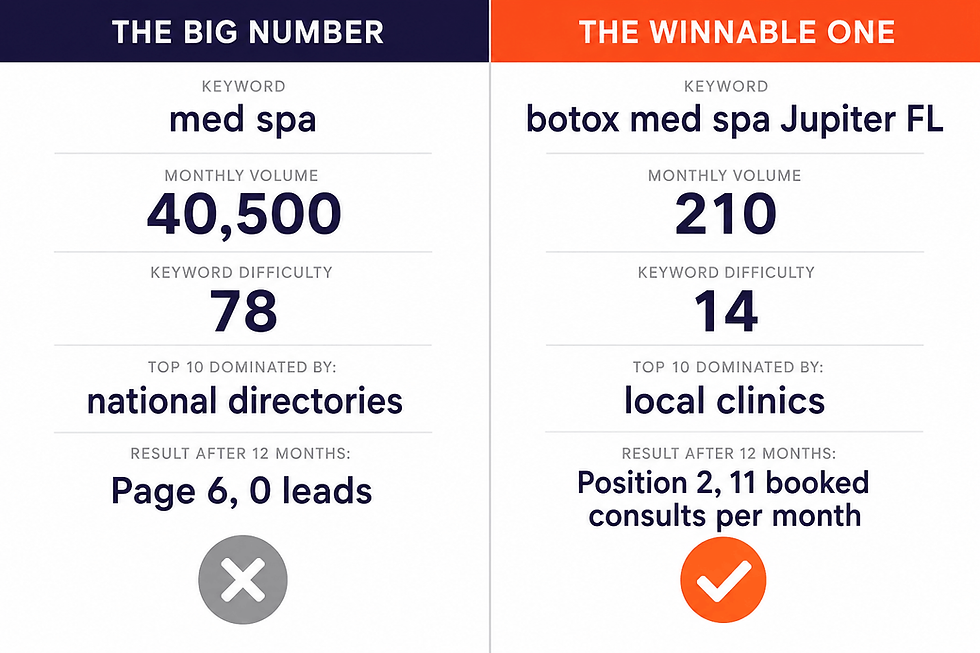
For example, a med spa in West Palm Beach could target a broad beauty keyword and still get visitors who are not local, not ready to book, or not interested in the specific treatment the med spa offers. A Boca Raton salon could publish weekly blog posts and still miss the high-intent searches that lead to appointments.
A real SEO content marketing strategy looks at the full path from search to action.
Why rankings alone do not mean success
In my experience, rankings by themselves do not mean much if there is no business plan behind them.
A page can rank and still fail if:
The keyword attracts the wrong audience.
The content does not answer the real question.
The page has no clear next step.
The service being promoted is not profitable.
The visitor is not local enough to become a customer.
The content gets traffic but does not support calls, bookings, visits, or sales.
That is why SEO and content should not be treated as separate tasks. They work best as one system.
How SEO Works in Content Marketing
SEO helps people find your content through search. Content marketing helps people understand, trust, and choose your business.
That is a useful way to think about SEO content development because the goal is not only visibility. The goal is clarity for both search engines and people.
SEO helps search engines understand your content
Search engines need to understand what your page is about, who it is useful for, and how it relates to the rest of your website.
That happens through:
Clear page titles.
Useful headings.
Specific service or topic coverage.
Internal links.
Descriptive URLs.
Helpful images and alt text when relevant.
Content that answers the searcher’s question directly.
If your website is confusing, thin, outdated, or disconnected, search engines may have a harder time understanding which pages deserve visibility.
Content helps people decide whether to trust you
The human side matters just as much.

A potential customer wants to know:
Do you understand my problem?
Do you offer the service I need?
Are you local?
Can I trust you?
What happens next?
Why should I choose you instead of another business?
Google’s guidance on helpful, reliable, people-first content emphasizes creating content for people, not content made mainly to manipulate rankings.
That lines up with what I see in real businesses. Content that only repeats keywords usually feels empty. Content that answers real customer questions, explains choices clearly, and connects to the right service pages has a much better chance of helping the business.
The goal is not just traffic, it is qualified action
Traffic is useful only when it supports the business.
For a local service business, that may mean:
Business type | Better SEO content goal |
Med spa | More qualified consultation requests |
Beauty salon | More local appointment bookings |
Retail shop | More visits, product interest, or online sales |
Contractor | More estimate requests from the right service area |
Professional service business | More calls from high-intent prospects |
A content marketing SEO effort should not stop at “we got more visitors.” It should ask what those visitors did next.
How Do You Integrate SEO Into Your Content?
You integrate SEO into your content by using search data, customer questions, and business goals before you create the content, not after.
Here is the practical process.
Start with the business goal
Before choosing a topic, ask what the business needs the content to support.
Examples:
A med spa may want more consultations for a specific treatment.
A salon may want more bookings for color services.
A retail business may want more visibility for a profitable product category.
A service business may want more calls for emergency or high-ticket services.
This keeps the SEO content plan grounded in revenue, not just traffic.
Match keywords to search intent
Not all keywords are equal.
Some people are researching. Some are comparing. Some are ready to book. Some are looking for a local provider right now.
For example:
Search intent | Example keyword | Best content type |
Informational | how does SEO work in content marketing | Educational blog post |
Strategic | seo content strategy | Full guide or service-supporting blog |
Local | SEO content strategy West Palm Beach | Local service page or locally focused blog |
Comparison | SEO vs content marketing | Comparison article |
High intent | SEO content specialist near me | Service page or consultation page |
A professional keyword research service can help separate informational searches from commercial, local, and high-intent terms before you build the content plan.
The mistake I see most often is treating every keyword like a blog topic. Some keywords deserve blog posts. Others deserve service pages, landing pages, FAQs, or updates to existing pages.
Build content around services, questions, and customer decisions
Strong SEO content usually fits into one of these categories:
Service pages for people close to hiring.
Blog posts for people researching questions.
Comparison content for people weighing options.
FAQ content for objections and decision support.
Local content for people searching by city, neighborhood, or service area.
Community content for businesses that need local relevance and trust.
A Boca Raton salon, for example, might need a strong color service page, blog posts about hair color maintenance, FAQs about pricing and appointments, and local content that reinforces its service area.
Use internal links to connect related pages
Internal links help people move through your website. They also help search engines discover and understand your related pages.
Google’s link best practices explain how links and descriptive anchor text help search engines understand page relationships.
A practical internal linking plan might connect:
A blog post about SEO content strategy to an SEO service page.
A local SEO article to a Boca Raton or West Palm Beach service-area page.
A med spa treatment blog to the related treatment page.
A retail buying guide to a product category page.
A FAQ section to a booking or consultation page.
This is one of the simplest ways to turn content into a system instead of a pile of separate pages.
Measure what happens after people land on the site
SEO content should be measured with more than rankings.
Search Console performance reports can show data like clicks, impressions, click-through rate, average position, queries, and pages in Google Search results. That helps you understand how people are discovering your content.
Then Google Analytics acquisition reports can help you understand what people do after they arrive from different channels.
Look at questions like:
Did the visitor call?
Did they book?
Did they fill out a form?
Did they visit a service page?
Did they leave quickly?
Did they come from a local search?
Did the content support a profitable service?
This is where SEO content strategy becomes different from guesswork.
Why Local Businesses Need a Different SEO Content Plan
A local business does not need traffic from everywhere. It needs the right traffic from the right area.
For businesses in West Palm Beach, Boca Raton, and Palm Beach County, local SEO services can help connect website content, Google visibility, local relevance, and customer action.
That is especially important for businesses in West Palm Beach, Boca Raton, and Palm Beach County.
West Palm Beach and Boca Raton businesses need local intent

Google says local search ranking factors are mainly based on relevance, distance, and prominence. For a local business, that means your content should help Google and potential customers understand:
What you offer.
Where you offer it.
Who you serve.
Why your business is relevant.
Whether people trust you.
How your website, Google Business Profile, reviews, and local signals connect.
A med spa in West Palm Beach does not need national traffic from people who will never book. A Boca Raton salon does not need clicks from someone three states away. A retail shop does not need vague visibility if it does not lead to store visits, calls, product interest, or sales.
Med spas, salons, retail shops, and service businesses need different content paths
Different businesses need different SEO content strategies.
Business type | Content that usually matters |
Med spa | Treatment pages, consultation FAQs, before-care and after-care content, comparison posts |
Beauty salon | Service pages, pricing guidance, maintenance tips, style inspiration, appointment FAQs |
Retail business | Product category pages, buying guides, local shopping content, seasonal content |
Local service business | Service pages, problem-solving blogs, location pages, estimate FAQs, emergency content |
The content should match how that customer makes a decision.
A person researching a med spa treatment may need education, safety information, expectations, and a consultation CTA. A person looking for a salon may want service details, pricing guidance, photos, reviews, and easy booking. A person hiring a contractor may want proof, service area clarity, and a fast estimate path.
Your website, Google Business Profile, reviews, and local content should support each other
Local SEO content does not live alone.
It should support and be supported by:
Your Google Business Profile.
Your service pages.
Your location or service-area pages.
Your reviews.
Your photos.
Your FAQs.
Your local backlinks or mentions.
Your contact and booking pages.
When these pieces say the same thing clearly, your local presence becomes easier for customers and search engines to understand.
What an SEO Content Marketing Strategy Should Include
A strong SEO content marketing strategy should include research, planning, creation, optimization, promotion, and measurement.
A structured SEO content strategy service can turn keyword research, competitor analysis, topic clustering, and content briefs into a ready-to-write plan.
Here is what that looks like in practice.
Website and content audit
Start by reviewing what already exists.
Look for:
Pages that already get traffic.
Pages with impressions but low clicks.
Service pages that are too thin.
Blog posts that rank but do not convert.
Content that is outdated.
Pages competing with each other for the same keyword.
Missing internal links.
Weak titles and headings.
Pages that do not have a clear CTA.
Sometimes the best SEO move is not creating a new blog post. It is improving a page that already has potential.
Keyword and topic research
Keyword research should answer more than “what has search volume?”
It should identify:
What your audience searches before they buy.
Which terms show local intent.
Which keywords connect to profitable services.
Which questions belong in FAQs.
Which topics need full pages.
Which topics only need short supporting sections.
Which searches suggest someone is ready to take action.
For local businesses, a lower-volume keyword can still be valuable if it brings in the right person.
Competitor gap analysis
Competitor research helps you see what other businesses explain better than you.
Look at:
Their service pages.
Their blog topics.
Their FAQs.
Their titles and headings.
Their internal links.
Their local pages.
Their reviews and trust signals.
Their calls to action.
The goal is not to copy them. The goal is to find what searchers need that your site does not explain yet.
Service page and blog planning
Service pages and blog posts do different jobs.
Service pages should target people closer to taking action. Blog posts should answer questions, build trust, and support those service pages.
For example, a med spa might need:
A service page for a specific treatment.
A blog post comparing treatment options.
A FAQ section about appointment preparation.
An internal link from the blog to the service page.
A CTA to book a consultation.
That is SEO content development with a purpose.
Local content and community content planning
An SEO plan for community content can help when local relevance matters.
This may include:
Local event tie-ins when they are natural.
Neighborhood or service-area content.
Local guides connected to your business category.
Community involvement pages.
Local partnership content.
Content that answers city-specific customer questions.
For example, a Boca Raton salon could create content around preparing for local events, seasonal humidity and hair care, or service-specific questions from local clients. A West Palm Beach med spa could create locally relevant treatment education that connects to consultations without sounding forced.
The key is relevance. Do not create local content just to mention the city. Create it because it helps the customer.
Internal linking plan
Every content plan should include internal links.
Before publishing a new page, ask:
What existing page should link to this?
What should this new page link to?
Which service page does this support?
What next step should the reader take?
Is there a related blog post that expands the topic?
This helps content support the whole website instead of sitting alone.
Measurement and improvement plan
SEO content strategy is not finished when the page goes live.
Track:
Rankings.
Clicks.
Impressions.
Click-through rate.
Calls.
Form submissions.
Bookings.
Sales.
Internal link clicks.
Service page visits.
Conversion rate.
Assisted conversions when available.
Then improve the content based on what the data shows.
SEO Content Development: What to Create First
The right order depends on your website, but most businesses should start with the pages closest to revenue.
When the strategy is clear, SEO content writing services can help turn that plan into optimized service pages, blog posts, website copy, articles, and product content.
Service pages for high-intent searches
If your service pages are weak, fix those before publishing endless blog posts.
A service page should clearly explain:
What the service is.
Who it is for.
What problems it solves.
Your service area.
What makes your approach different.
Common questions.
Next steps.
How to call, book, buy, or request an estimate.
For many local businesses, service pages are where the money is.
Blog posts for questions and comparisons
Blog posts are useful when they answer real questions your customers ask before they hire or buy.
Good blog topics might include:
“How does SEO work in content marketing?”
“How do you integrate SEO into your content?”
“What should an SEO content plan include?”
“SEO vs content marketing: what is the difference?”
“When should a local business hire an SEO content specialist?”
The blog should support the sales path, not distract from it.
FAQs for objections and decision support
FAQs can help answer the questions that stop someone from taking action.
Examples:
How much does this cost?
How long does it take?
Is this right for my business?
Do I need a specialist?
Can I do some of this myself?
What happens after I book a consultation?
For SEO, FAQs can also help cover long-tail searches naturally.
Local pages or community content when relevant
Local pages can be useful when your business serves multiple areas, but they need real value.
A page for Boca Raton or West Palm Beach should not be a duplicate page with the city name swapped out. It should explain what is relevant to that location, who you serve there, and why the page helps a local searcher.
Updates to existing content before creating something new
One of the biggest missed opportunities I see is businesses constantly creating new content while ignoring pages that already have some traction.
Before writing something new, check whether an existing page could be improved with:
Better headings.
Updated information.
Clearer examples.
Stronger internal links.
More helpful FAQs.
Better local relevance.
A clearer CTA.
More complete topic coverage.
Sometimes updating an existing page is faster and more valuable than starting from scratch.
Promoting Content Through SEO
Promoting content through SEO means making the content easier to discover, understand, trust, and act on.
It is not only about sharing a link once after publishing.
Make content crawlable and easy to understand
Your content should be:
Easy to access.
Linked from relevant pages.
Organized with clear headings.
Written around a specific topic.
Supported by useful internal links.
Free of unnecessary confusion or duplication.
Use titles, descriptions, headings, and links intentionally
Your title and headings should help both the reader and search engine understand the page.
A strong title should be specific, not vague.
Instead of:
SEO Tips
Use:
SEO Content Strategy for Local Businesses: How to Turn Content Into Leads
That is clearer, more useful, and more aligned with search intent.
Share useful content where your audience already pays attention
SEO can work with other promotion channels.
Depending on the business, that may include:
Email newsletters.
Google Business Profile updates.
Social media.
Local partnerships.
Sales follow-ups.
Community groups.
Paid ads.
Referral conversations.
The best promotion is relevant. Share content where it helps people, not everywhere just to check a box.
Refresh and improve content based on performance
SEO content should be improved over time.
Refresh content when:
Rankings drop.
The information becomes outdated.
Competitors add better answers.
Search intent changes.
A service changes.
A page gets impressions but few clicks.
A page gets traffic but no leads.
New customer questions come up.
Good SEO content is maintained, not abandoned.
How AI, LLMs, and GEO Affect SEO Content Strategy
AI has changed how people create and discover content, but it has not removed the need for SEO strategy.
In fact, it makes strategy more important.
Foundational SEO still matters
Businesses should not abandon SEO basics just because AI search is growing.
The foundation still matters:
Helpful content.
Clear structure.
Crawlable pages.
Good internal links.
Strong service pages.
Local relevance.
Trust signals.
Accurate information.
Search intent alignment.
Clear structure and complete topic coverage matter more now
With AI Overviews, LLMs, and GEO, content needs to be easier for both people and systems to understand.
That means:
Answer the main question early.
Use logical headings.
Explain related subtopics clearly.
Avoid vague filler.
Add useful examples.
Connect related pages.
Show real experience when possible.
Keep information accurate and current.
My view is simple: AI makes average content easier to produce, which means strategy, clarity, experience, and usefulness matter even more.
AI can help execute content, but it should not replace strategy
AI can help with drafts, outlines, summaries, title ideas, FAQs, and content updates.
But AI should not decide your entire SEO content marketing strategy without expert guidance.
The hard part is not typing the content. The hard part is connecting:
Search behavior.
Customer psychology.
Local competition.
Website structure.
Analytics.
Service profitability.
Conversion paths.
Brand voice.
Business goals.
If you understand basic web design, you may be able to publish pages, adjust headings, add internal links, and update service content yourself. But the strategy should be built by someone who knows how SEO, content marketing, and local business growth fit together.
When Should You Hire an SEO Content Specialist?
You should consider a managed SEO service when you are creating content but cannot clearly connect it to better visibility, better leads, or better business outcomes.
When you are publishing but not getting leads
If you are blogging regularly but not seeing calls, bookings, sales, or consultation requests, the issue may not be effort. It may be strategy.
You may be targeting the wrong topics, missing high-intent pages, failing to link content properly, or attracting people who are not ready to act.
When you are ranking for the wrong terms
Ranking for the wrong keyword can look like success in a report but feel like failure in the business.
For example:
A salon ranks for a broad style idea but not its actual services.
A med spa ranks for a beauty trend but not consultation-driven treatment searches.
A service business ranks for DIY questions but not hiring-intent terms.
A retailer gets traffic to informational content but not product or category pages.
An SEO specialist can help separate vanity visibility from useful visibility.
When you need a strategy before creating more content
More content is not always the answer.
Sometimes the better move is:
Improve service pages.
Merge overlapping blog posts.
Build topic clusters.
Add internal links.
Create local pages.
Rewrite titles and meta descriptions.
Add FAQs.
Update outdated content.
Build a stronger conversion path.
A clear SEO content plan helps you know what to do first.
When your team can implement but needs expert direction
This is where many business owners can save time and money.
You may not need someone to do every single task forever. You may need a professional to build the strategy, set priorities, create the roadmap, and guide implementation.
Then your team can help with:
Publishing.
Basic edits.
Adding photos.
Updating FAQs.
Sharing posts.
Collecting customer questions.
Sending real-world insights.
Using AI for first-pass support.
That combination often works better than either guessing alone or outsourcing without understanding the plan.
SEO Content Strategy FAQs
How do you integrate SEO into your content?
You integrate SEO into your content by planning around search intent, business goals, keyword opportunities, internal links, local relevance, and conversion paths before writing. Start with what your audience needs, match topics to the right page type, create helpful content, and measure what happens after people arrive.
How does SEO work in content marketing?
SEO helps your content get discovered in search. Content marketing helps educate, build trust, and move people closer to action. Together, they help the right people find the right information at the right time.
What should an SEO content plan include?
An SEO content plan should include a content audit, keyword research, topic mapping, competitor gap analysis, service page priorities, blog topics, local content opportunities, internal links, promotion steps, and performance tracking.
Is SEO content strategy only for blogs?
No. SEO content strategy includes service pages, product pages, location pages, FAQs, blog posts, comparison pages, guides, case studies, and updates to existing content. For many local businesses, service pages are more important than blog posts.
Can AI help with SEO content marketing?
Yes, AI can help with brainstorming, outlining, drafting, summarizing, and updating content. But AI should work under a clear SEO strategy. It should not replace research, search intent analysis, local market understanding, customer insight, or conversion planning.
What is an SEO plan for community content?
An SEO plan for community content is a local content strategy that connects your business to the area you serve. It may include local guides, event-related content, neighborhood pages, partnership content, or city-specific customer questions. It should be useful, not just a way to repeat location keywords.
How often should a business update its SEO content strategy?
Most businesses should review their SEO content strategy at least quarterly. You may need to update it sooner if rankings shift, services change, competitors improve their content, AI search behavior changes, or your website is getting traffic that does not turn into leads or sales.
Final Thoughts: SEO Content Strategy Is a Business System, Not a Checklist
SEO content strategy works best when it connects search behavior, customer needs, local competition, website structure, and business goals.
For businesses in West Palm Beach and Boca Raton, the goal is not to get random traffic. The goal is to attract the right local people and help them take the next step.
That is why I do not treat SEO as something you sprinkle onto content after it is written. SEO should shape the plan from the beginning. When it does, your content becomes more than marketing activity.
If you want help turning SEO, content, and local visibility into a clearer growth plan, schedule a discovery call with Kendall Development.


Comments